
 Phone
+44 (0)203 4882 308
Phone
+44 (0)203 4882 308

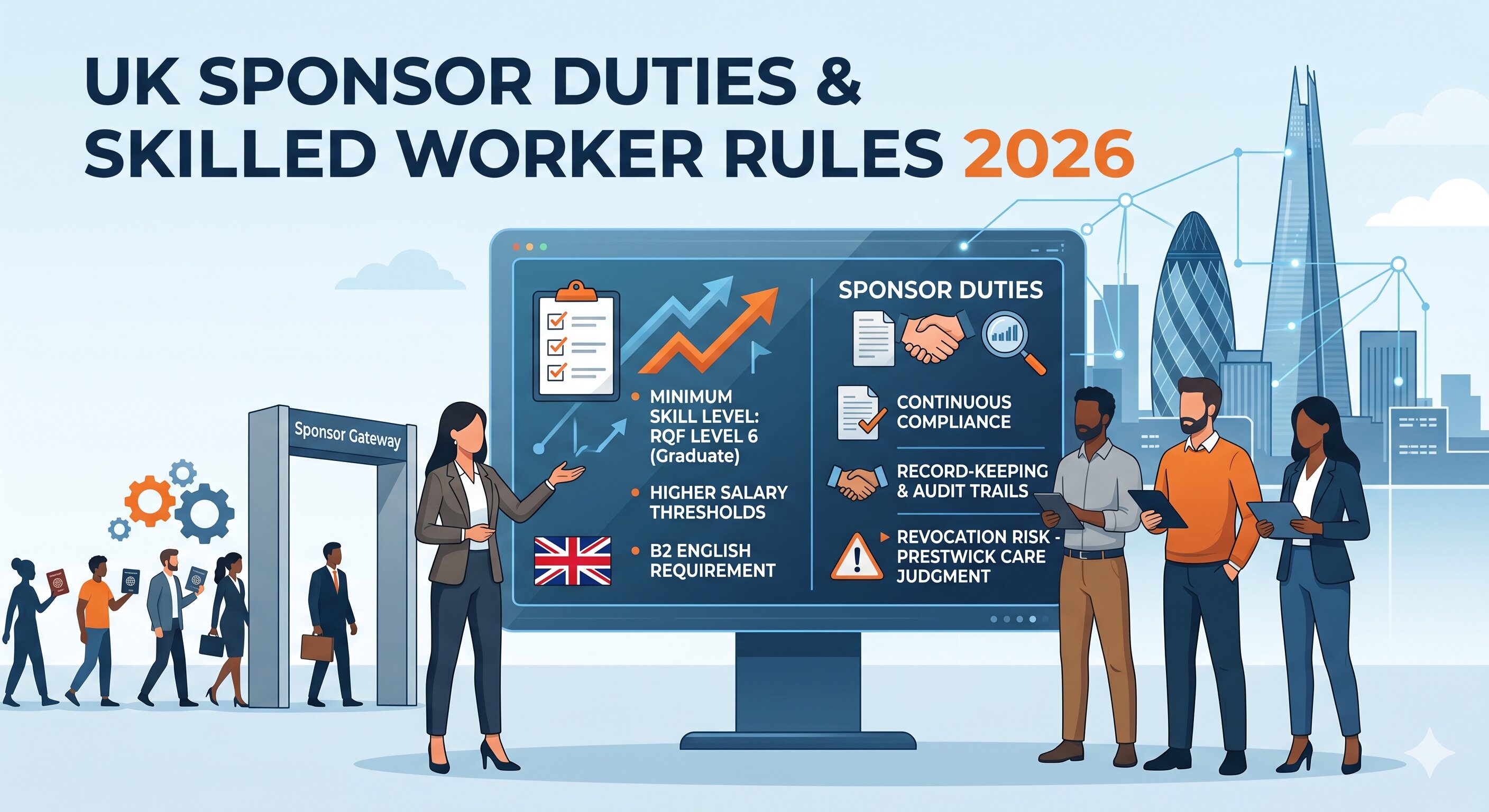
UK Sponsor Duties and Skilled Worker Rules in 2026: What Every UK Employer Must Know
The rules that govern how UK employers hire international talent have changed more in the last eighteen months than in the previous decade. Between the abolition of sponsor licence guidance renewals in April 2024, the comprehensive Skilled Worker rewrite on 22 July 2025, and the new B2 English requirement introduced in January 2026, the Home Office has fundamentally rewritten the compact between the state and the UK's sponsoring employers.
For SMEs, HR managers, and business owners, this is not an academic shift. Getting it wrong in 2026 means losing your sponsor licence, losing your sponsored workforce, and — as the Court of Appeal confirmed in Prestwick Care Ltd v Secretary of State — having almost no realistic route to challenge a revocation in court.
This guide walks through the two big shifts UK employers must understand in 2026: the rewritten Skilled Worker route, and the tightened sponsor compliance regime sitting behind it.
Part 1: The Skilled Worker Route, Rewritten
On 22 July 2025, the Home Office implemented the most significant structural change to the Skilled Worker visa route since it replaced Tier 2 (General) in December 2020. The changes narrow the route dramatically, and they affect every UK organisation that relies on sponsored labour.
Minimum Skill Level Raised to RQF Level 6
Before July 2025, the Skilled Worker route accepted roles at RQF Level 3 — roughly A-level equivalent. A long list of mid-skilled occupations qualified: care workers, chefs, some technicians, butchers, and skilled trade roles across construction and hospitality.
From 22 July 2025, the minimum skill level was raised to RQF Level 6 — graduate equivalent. In practice, this means:
- Roles must be at degree level or higher to qualify
- Around 180 occupation codes previously eligible under the route no longer qualify
- The route is now squarely aimed at higher-skilled, higher-paid professional positions
For employers that have historically relied on the Skilled Worker route to recruit mid-skilled staff, this is a structural problem. Roles that were sponsored pre-July 2025 may not be renewable under the new regime at the next certificate of sponsorship.
Higher Salary Thresholds
Alongside the skill-level change, the salary thresholds have climbed sharply. The general threshold, the going rate for each occupation code, and the "new entrant" discount have all been recalibrated upwards. The policy intent is transparent: the Home Office wants sponsorship reserved for genuinely skilled, well-paid roles — and it is using the price mechanism to enforce that preference.
The practical consequence for UK employers is that the total cost per sponsored worker has risen in two places at once: higher direct salary, and higher compliance overhead.
B2 English from January 2026
Layered on top of the July 2025 changes, a new B2 level English requirement has applied to the Skilled Worker route since January 2026, replacing the previous B1 minimum. B2 on the Common European Framework of Reference (CEFR) requires independent use of English — the ability to understand complex text, converse fluently, and produce detailed writing.
For employers, this means:
- Overseas candidates must meet a higher linguistic bar before entry clearance
- Existing sponsored workers renewing leave must re-evidence English at the new level where applicable
- Recruitment pipelines that previously converted at B1 will drop candidates who cannot yet evidence B2
Why July 2025 and January 2026 Matter Together
The July 2025 and January 2026 changes are best read as a single policy package. Taken together, they mean the Skilled Worker route is now narrower in scope, higher in cost, and more demanding of both sponsors and applicants than at any previous point in its history.
Getting it wrong in 2026 means losing your sponsor licence, losing your sponsored workforce, and having almost no realistic route to challenge a revocation in court. — Prestwick Care Ltd v Secretary of State
Part 2: Sponsor Duties, Tightened
The Skilled Worker rewrite has drawn most of the headlines, but for holders of existing sponsor licences, the quieter story is just as consequential: the Home Office has fundamentally tightened what it expects of sponsors day to day.
The Abolition of Renewals (April 2024)
In April 2024, the requirement to renew a sponsor licence every four years was abolished. On paper, that looks like deregulation. In practice, it shifts the compliance model entirely.
- Old model: sponsors made an effort at the renewal window and were reviewed periodically
- New model: sponsor licences are perpetual in principle, but subject to continuous Home Office oversight — meaning random audits, action plans, and revocations now form the main control mechanism
If anything, abolishing renewals has raised the stakes of every routine compliance decision. There is no longer a moment where a sponsor's house must be put in order; the house must be in order at all times.
Eligible Roles Must Be Genuine
The Home Office now pays particular attention to whether sponsored roles are substantively real, not merely formally classified. Its inspectors increasingly ask:
- Does the role genuinely exist within the business?
- Does the Standard Occupational Classification (SOC) code actually match the work being done?
- Is the role required by the business, or manufactured to support sponsorship?
This is a shift from a formal, paperwork-based review to a business reality review. A role that "looks right on paper" but does not match what the employee does day to day is now a serious compliance risk, even where the paperwork is otherwise flawless.
Salary Compliance — Paid, Not Promised
Salary compliance has moved from theory to practice:
- Salaries must be paid in consistent monthly instalments
- Payroll records must exactly align with the Certificate of Sponsorship
- Irregular payments, late payments, or "top-up" arrangements that pull annual pay up to threshold no longer suffice
The Home Office is checking whether the sponsored worker is actually receiving the declared salary, in the declared pattern, every pay period. An employee paid less in January and "caught up" in March is treated as a compliance failure, not a timing issue.
Worker Protection Is Now a Sponsor Duty
Working conditions, contractual terms, and financial arrangements used to be treated as employment law matters — a separate conversation from immigration compliance. No more.
The Home Office now treats worker protection as a core sponsor duty. That includes:
- The terms of the employment contract
- Deductions from salary (for accommodation, training, uniforms, or any other reason)
- Working hours and working location
- Grievance, whistleblowing, and welfare mechanisms
A sponsor who exploits its workers — even where the exploitation might be technically lawful under employment law — is now at immediate risk of licence revocation.
Record Keeping Must Show the Decision Trail
Documentation requirements have moved from a checklist exercise to an audit trail. The Home Office expects to see the reasoning behind:
- Recruitment decisions (why this candidate, what the shortlist looked like)
- Role design (why this SOC code, why this salary band)
- Ongoing compliance reviews (what was checked, by whom, when)
Gaps in this trail are increasingly treated as indicators of deeper problems. A missing recruitment file is no longer read as "paperwork not kept" — it is read as "the recruitment process may not have happened at all."
Real Time Monitoring of Sponsored Workers
Hybrid and remote working have created new sponsor obligations. Sponsors must know, in real time:
- Where sponsored workers are physically working from
- Whether their actual duties still match their Certificate of Sponsorship
- Whether any change in circumstances has been reported within the required window (typically 10 or 20 working days)
"We didn't realise he had moved to Manchester" is not a defensible position under the current guidance.
Consider a sponsor licence compliance audit to assess your current compliance posture before the Home Office does it for you.
Part 3: The Prestwick Care Judgment — Why There Is Nowhere to Hide
The policy changes above are being enforced against a legal backdrop that strongly favours the Home Office. The Court of Appeal's decision in Prestwick Care Ltd v Secretary of State for the Home Department crystallised three points sponsors cannot afford to ignore.
1. Broader business consequences are not the Home Office's problem. The Court confirmed that when deciding to revoke a sponsor licence, the Home Office does not have to weigh the impact on the wider business, the economy, or the affected workers. Loss of livelihood is a consequence of revocation, not a defence against it.
2. Multiple minor failings add up to systemic non-compliance. Historically, some sponsors argued that a handful of small errors across a population of workers was unfortunate but not systemic. Prestwick Care closed that door. A pattern of minor failings can now justify full revocation, even where no single failing would have done so on its own.
3. Sponsorship is a conditional privilege. The Court reaffirmed that holding a sponsor licence is not a right. It is a privilege extended by the state on strict conditions. Where a sponsor falls below standard, the licence can be removed — and the courts will not readily second-guess that decision on proportionality grounds.
The practical consequence for UK employers: challenging a revocation in court is now much harder than it once was. Prevention beats cure, by a wide margin.
Part 4: What UK Employers Must Do Now
The rules have changed. Here is a practical action list for 2026.
1. Audit Your Sponsor Licence Immediately
Do not wait for a Home Office visit. Commission an internal — or, ideally, external — sponsor compliance audit that checks:
- Every sponsored worker's actual salary against their Certificate of Sponsorship
- Every sponsored worker's real duties against the declared SOC code
- HR records, right to work files, and the Sponsor Management System (SMS)
- Key personnel listed on the SMS, their training, and their understanding of sponsor duties
2. Re-evaluate Your Skilled Worker Pipeline
If your business relies on sponsored workers, map your roles against the post July 2025 RQF Level 6 eligibility and the current salary thresholds. Identify:
- Roles that are no longer sponsorable at all
- Roles where you will need to raise salaries to continue sponsoring
- Roles where domestic recruitment, apprenticeships, or internal training pathways are now more cost effective than sponsorship
3. Tighten Your Record Keeping
Treat every recruitment decision as though it will be audited. In practice, that means:
- A written rationale for the role and its skill level
- A clear recruitment file, including shortlist and selection reasoning
- An auditable trail of salary decisions and benchmarking
- A dated, signed compliance review on every sponsored worker, at least annually
4. Set Up Real-Time Monitoring
You need a live picture of:
- Where each sponsored worker is working from
- Whether their duties still match their Certificate of Sponsorship
- Any changes that require a report to the Home Office, within the statutory window
5. Plan for the B2 English Requirement
For any Skilled Worker application made on or after January 2026, candidates must evidence B2 English. Build this check into your offer to start date workflow and make it explicit in candidate communications.
6. Get Specialist Immigration Advice Early
The cost of a revoked sponsor licence — in workforce disruption, reputational damage, and the near impossibility of quick reinstatement — dwarfs the cost of good legal advice. In 2026, specialist advice is not a luxury; it is operational risk management.
Frequently Asked Questions
1. Does the July 2025 rewrite affect existing Skilled Worker visa holders?
Existing visa holders can generally remain on their current conditions until the next application point — an extension, a change of employment, or settlement. The new rules apply to new Certificate of Sponsorship assignments and certain renewals. Specialist advice is essential because the treatment of transitional cases depends on the exact facts.
2. My care sector roles no longer qualify under RQF Level 6. What are my options?
Options include: recruiting domestically, using the narrower Health and Care Worker route where eligible, restructuring roles so they genuinely meet RQF Level 6 criteria, or raising salaries and responsibilities to meet the new thresholds. Each option has legal and commercial trade-offs; a workforce strategy review is the right starting point.
3. How often does the Home Office audit sponsor licences in 2026?
There is no set schedule. Audits can be announced or unannounced. Since April 2024, the emphasis has moved from renewal-triggered reviews to continuous, risk-based compliance checks, including desk-based audits, SMS data reviews, and on-site visits.
4. What happens if my organisation loses its sponsor licence?
Sponsored workers typically lose their permission to work within 60 days, or when their existing leave expires, whichever is sooner. The business cannot sponsor new workers. Re-application is subject to a cooling-off period of at least 12 months, and the renewed application faces heightened scrutiny. The knock-on effects to individual workers — including settlement timelines — can be severe.
5. Do I still need to renew my sponsor licence?
No. Since April 2024, sponsor licences no longer expire and do not require renewal. Licences are subject to continuous oversight instead, and can be revoked at any time for non-compliance. The abolition of renewals should not be read as a reduction in the compliance burden.
6. Is B2 English a one-off check or an ongoing requirement?
The B2 English level introduced in January 2026 applies at the point of application. Extensions and certain route change applications may require re-evidencing. Indefinite Leave to Remain (ILR) applicants should plan their English evidence as part of the naturalisation timeline.
How Worldwide Immigration Helps UK Employers Stay Compliant
Worldwide Immigration Ltd provides specialist support to UK SMEs, HR teams, and business owners navigating the rewritten Skilled Worker route and the tightened sponsor licence regime. Our services include:
- Sponsor licence applications and key personnel training
- Sponsor compliance audits modelled on Home Office methodology
- Skilled Worker, ILR, and British Citizenship applications for individual employees
- Ongoing sponsor management advice, including real time monitoring systems
- Defence against compliance action, including licence revocation and downgrading
With the Home Office operating a near zero tolerance approach and the Court of Appeal backing its enforcement discretion, 2026 is not the year to handle UK immigration compliance in house without specialist input.
Protect Your Sponsor Licence and Your Workforce
Book a confidential sponsor compliance review today.
- Call: +44 203 4882 308
- Email: inquiry@worldwideimmigration.co.uk
- Visit: 124 City Road, London, EC1V 2NX
Remote consultations are available throughout the UK and internationally. Contact us today to get started.
This article is provided for general information and does not constitute legal advice. UK immigration law changes rapidly; please contact Worldwide Immigration Ltd for guidance on your specific circumstances.